Summer School for Climate-Environmental Research on the Siberian peatlands “Peatland Carbon Cycle: From Field to Publication”
1. General Information
Organizers: Yugra State University
Venue: Mukhrino Field Station, Khanty-Mansiysk Autonomous okrug - Yugra, Russia
Dates: August 31 – September 9, 2026
Total Duration: 10 days (including arrival/departure days)
Arrival/Departure: 2 days (logistics)
Fieldwork: 6 days at the Mukhrino Field Station
Lab & Results Presentation: 2 days at Yugra State University
Participants: Up to 16 early-career researchers and PhD students
Outcome: Certificate of participation + joint publication in a peer-reviewed journal
Deadline for participation applications: May 31, 2026
Announcement of approved participant candidates: June 10, 2026
2. Main Objective
To enhance collaboration and methodological alignment in studying the peat–soil–vegetation carbon cycle through integrated field, lab, and data analysis approaches.
3. Thematic Focus
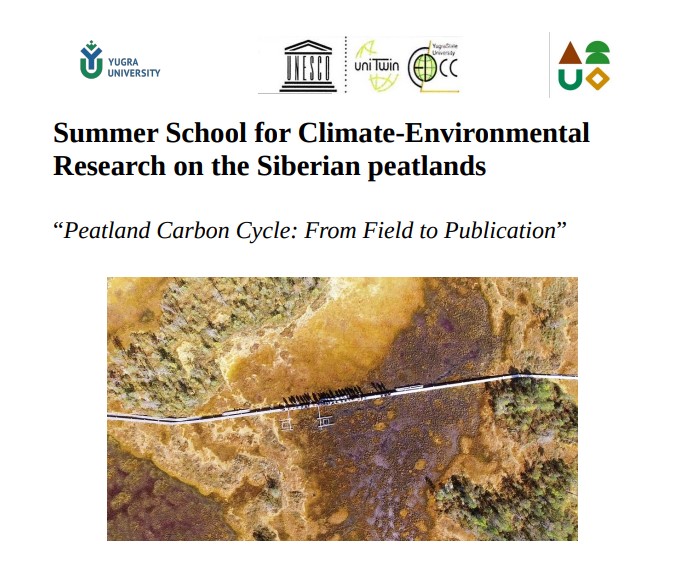
Western Siberia is the most waterlogged territory in the world, containing approximately 40% of the global peat deposits accumulated over the last ~12,000 years. The main object of the Summer School is the peat deposit as a record of environmental change and a key component of the carbon cycle. The program is structured around six interconnected thematic areas, each corresponding to specific field and laboratory methods:
Peatland Landscape Structure: Participants will learn visual description techniques, vegetation mapping basics using GIS, and explore methods for assessing peatland spatial structure and heterogeneity (including machine learning techniques).
Peat Stratigraphy and Carbon Pool Assessment: Hands-on training in peatland structure investigation, peat core extraction, and basic physical-chemical property measurements to calculate carbon accumulation rates and stocks.
Hydrological Function and Hydrochemistry: Field sampling of surface and bog waters, combined with data analysis from the automated data-loggers (EXO-2 and AquaTroll) and monitoring wells to understand peatland hydrology.
Peat as a Habitat: An introduction to using bio-indicators (testate amoebae, plant macrofossils) to reconstruct past environmental conditions and understand the peatland as a living ecosystem.
Ecosystem Functions and Services: A practical overview of methods for assessing peatland ecosystem services, including an introduction to modeling tools for regulating functions such as carbon storage and water regulation.
Meteorological Data and Greenhouse Gas Fluxes: A practical session on processing and visualizing time series: plotting air/soil temperature dynamics, precipitation patterns, solar radiation, air pressure and wind direction and velocity. Participants will also work with greenhouse gas flux data, focusing on calculation routines and graphical interpretation of seasonal trends.
Additional information:
Venue: Russian Federation, Khanty-Mansiysk city and Mukhrino Field Station (Western Siberia), 61.002 N, 69.018 E
Course fee: 65 000 RUR / 900 USD / 750 EUR / 6000 CNY The course fee includes full coverage of the following essential components: Inclusions:
Accommodation for the entire duration of the event
Internal logistics, including all transfers between Khanty-Mansiysk city and the Mukhrino Field Station
Meals throughout the program period
Participation in all academic sessions, fieldwork, and laboratory activities
Certificate of Completion issued by Yugra State University
1. General Information
Organizers: Yugra State University
Venue: Mukhrino Field Station, Khanty-Mansiysk Autonomous okrug - Yugra, Russia
Dates: August 31 – September 9, 2026
Total Duration: 10 days (including arrival/departure days)
Arrival/Departure: 2 days (logistics)
Fieldwork: 6 days at the Mukhrino Field Station
Lab & Results Presentation: 2 days at Yugra State University
Participants: Up to 16 early-career researchers and PhD students
Outcome: Certificate of participation + joint publication in a peer-reviewed journal
Deadline for participation applications: May 31, 2026
Announcement of approved participant candidates: June 10, 2026
2. Main Objective
To enhance collaboration and methodological alignment in studying the peat–soil–vegetation carbon cycle through integrated field, lab, and data analysis approaches.
3. Thematic Focus
Western Siberia is the most waterlogged territory in the world, containing approximately 40% of the global peat deposits accumulated over the last ~12,000 years. The main object of the Summer School is the peat deposit as a record of environmental change and a key component of the carbon cycle. The program is structured around six interconnected thematic areas, each corresponding to specific field and laboratory methods:
Peatland Landscape Structure: Participants will learn visual description techniques, vegetation mapping basics using GIS, and explore methods for assessing peatland spatial structure and heterogeneity (including machine learning techniques).
Peat Stratigraphy and Carbon Pool Assessment: Hands-on training in peatland structure investigation, peat core extraction, and basic physical-chemical property measurements to calculate carbon accumulation rates and stocks.
Hydrological Function and Hydrochemistry: Field sampling of surface and bog waters, combined with data analysis from the automated data-loggers (EXO-2 and AquaTroll) and monitoring wells to understand peatland hydrology.
Peat as a Habitat: An introduction to using bio-indicators (testate amoebae, plant macrofossils) to reconstruct past environmental conditions and understand the peatland as a living ecosystem.
Ecosystem Functions and Services: A practical overview of methods for assessing peatland ecosystem services, including an introduction to modeling tools for regulating functions such as carbon storage and water regulation.
Meteorological Data and Greenhouse Gas Fluxes: A practical session on processing and visualizing time series: plotting air/soil temperature dynamics, precipitation patterns, solar radiation, air pressure and wind direction and velocity. Participants will also work with greenhouse gas flux data, focusing on calculation routines and graphical interpretation of seasonal trends.
Additional information:
Venue: Russian Federation, Khanty-Mansiysk city and Mukhrino Field Station (Western Siberia), 61.002 N, 69.018 E
Course fee: 65 000 RUR / 900 USD / 750 EUR / 6000 CNY The course fee includes full coverage of the following essential components: Inclusions:
Accommodation for the entire duration of the event
Internal logistics, including all transfers between Khanty-Mansiysk city and the Mukhrino Field Station
Meals throughout the program period
Participation in all academic sessions, fieldwork, and laboratory activities
Certificate of Completion issued by Yugra State University
Дата:
02.03.2026